Education is often viewed through the lens of textbooks, lectures, and examinations. Yet, beneath this formal structure lies a timeless and powerful tool that has been shaping human learning for centuries: storytelling. Beyond mere entertainment, storytelling serves as a catalyst for deeper understanding, creativity, and emotional engagement in students. This article explores how storytelling enhances learning and retention, with practical insights for educators and parents seeking holistic development for their students.
The Timeless Tradition of Storytelling in Education
Storytelling predates formal education systems. From ancient tribal tales told around fires to classical myths and fables, stories have carried the wisdom, values, and knowledge essential for survival and social cohesion. The narrative form naturally captures human attention and stimulates the brain’s emotional centers, making learning both memorable and meaningful.
In classrooms today, storytelling remains a bridge between abstract concepts and students’ lived experiences. By embedding lessons within relatable characters and scenarios, stories help students internalize ideas, connect with the material emotionally, and build cognitive links crucial for long-term retention.
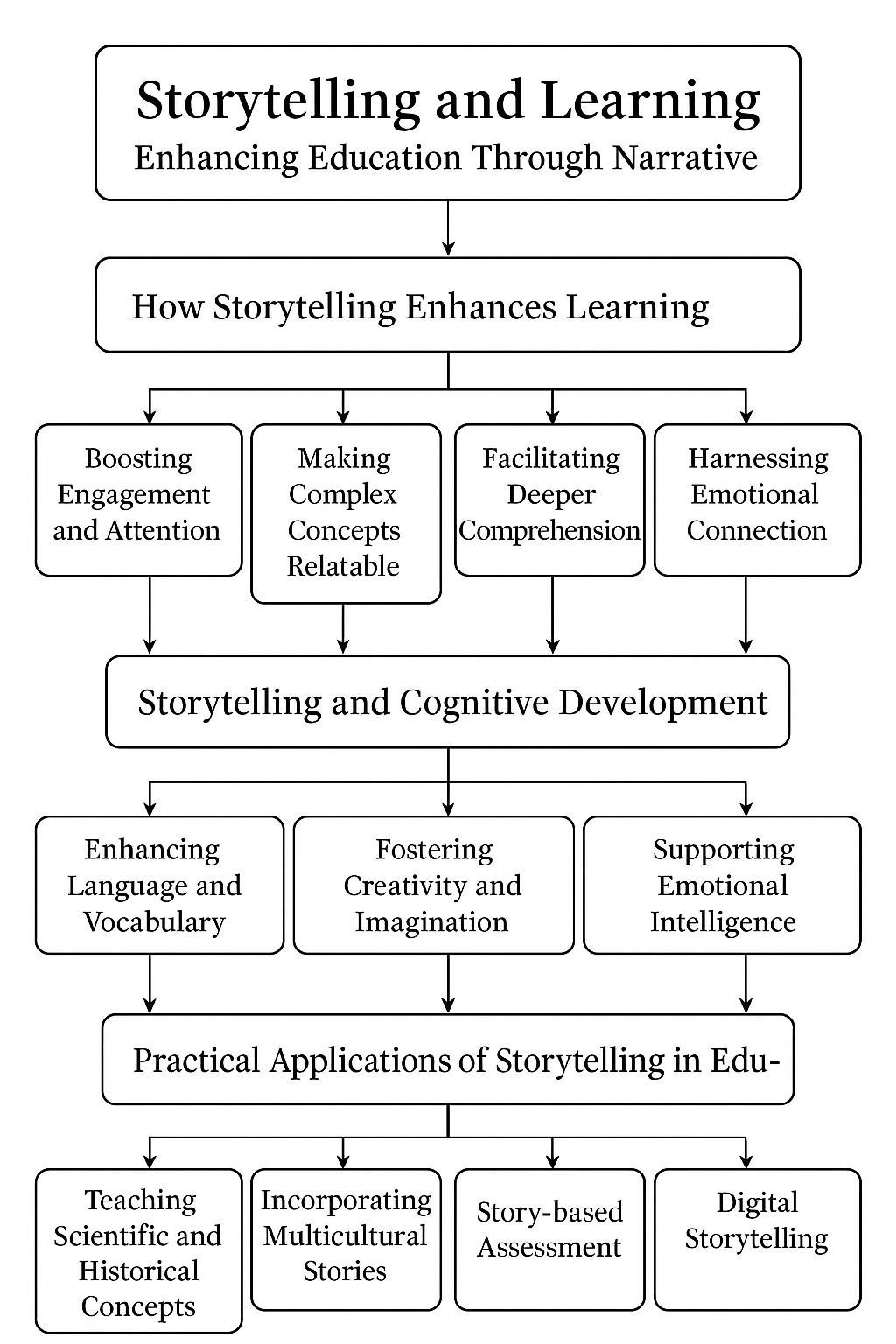
How Storytelling Enhances Learning
Boosting Engagement and Attention
Students often find lectures or rote memorization monotonous. Stories, by contrast, draw listeners in with intrigue, conflict, and resolution. Engaged learners pay closer attention, ask questions, and become active participants in lessons. This heightened involvement naturally improves understanding and curiosity.
Making Complex Concepts Relatable
Subjects like science, history, or ethics can be daunting or disconnected from students’ realities. Storytelling personalizes these topics by illustrating them through characters’ choices and experiences. For example, learning about electricity might be framed through a story about a young inventor’s curiosity, making the concept tangible and motivating.
Facilitating Deeper Comprehension
Human brains are wired to process narratives better than isolated facts. Stories provide context, cause-effect relationships, and emotional layers, allowing students to reconstruct and analyze information rather than merely memorize it. This cognitive engagement lays a foundation for critical thinking and problem-solving.
Harnessing Emotional Connection
Emotions play a pivotal role in learning. Storytelling evokes feelings—empathy, excitement, fear, or joy—that enhance memory encoding and retrieval. When students care about characters and outcomes, information embeds deeper in the brain’s networks, ready for future application.
ALSO READ:
Beyond Classrooms: How Zubeen Garg Redefines Real Education
Beyond Classrooms: How Zubeen Garg Redefines Real Education
Storytelling and Cognitive Development
Enhancing Language and Vocabulary
Regular exposure to stories enriches students’ vocabulary and grammatical understanding. Listening to or reading diverse narratives introduces new words and sentence structures naturally, supporting language acquisition across ages.
Fostering Creativity and Imagination
Stories spark students’ imaginations, encouraging them to visualize scenes, infer characters’ motives, and dream beyond the present. This imaginative exercise nurtures creativity, which is essential for innovation and adaptability in today’s rapidly changing world.
Supporting Emotional Intelligence
By exploring characters’ feelings, conflicts, and resolutions, students develop empathy and self-awareness. They learn to recognize emotions in themselves and others, improving interpersonal skills and emotional regulation vital for social success.
Practical Applications of Storytelling in Education
Teaching Scientific and Historical Concepts
Stories humanize historical figures or scientific discoveries, making them accessible. For instance, narrating Marie Curie’s perseverance in the face of obstacles nurtures both scientific curiosity and values like resilience and dedication.
Incorporating Multicultural Stories
Using stories from different cultures promotes inclusiveness and global awareness. For diverse classrooms, this practice fosters respect and understanding, preparing students for collaborative and multicultural environments.
Story-based Assessment
Instead of traditional exams, educators can use storytelling tasks—such as writing or performing narratives—to assess comprehension creatively. This method reduces test anxiety and reveals deeper learning.
Digital Storytelling
Modern multimedia tools enable students to create and share stories through videos, podcasts, and interactive apps. Digital storytelling integrates technology with creative expression, enhancing digital literacy alongside emotional and cognitive development.
Real-Life Success Stories of Storytelling in Education
Schools globally report improved student motivation and achievement when storytelling is integrated systematically. For example, an elementary school in a multicultural city introduced storytelling circles where students shared personal and cultural tales. Teachers observed heightened classroom cohesion, better language skills, and greater enthusiasm for learning across all subjects.
Similarly, educators in science have created story-driven modules where students role-play as young explorers or inventors, resulting in improved understanding and retention of scientific concepts. Student feedback often highlights the confidence gained through storytelling presentations and the joy of learning.
Tips for Educators and Parents to Use Storytelling
- Encourage Student Storytelling: Children should be invited to tell their own stories, fostering ownership and creative thinking.
- Integrate Across Subjects: Stories can introduce topics in math, science, social studies, and literature, making lessons interconnected and engaging.
- Select Age-Appropriate Stories: Choose narratives with themes and language suitable to students’ maturity and background.
- Use Repetition and Variation: Retelling stories with variations deepens comprehension and keeps interest alive.
- Create Safe Spaces: Allow emotional expression and diversity in student stories, fostering trust and respect.
- Leverage Multimedia: Incorporate audio, video, and digital storytelling tools to appeal to different learning styles.
Conclusion: Storytelling as a Catalyst for Lifelong Learning
In an era increasingly dominated by technology and data, the human touch of storytelling remains irreplaceable. It nurtures not just academic proficiency but emotional, social, and creative capacities essential for thriving in complex societies. Educators and parents who embrace storytelling empower students with tools to understand themselves and others, solve problems creatively, and engage deeply with the world.
Incorporated thoughtfully into curricula, storytelling transforms education from passive reception to active, imaginative participation, ensuring knowledge is retained and lives are enriched.